

EDAA Achievement Award 2026 goes to Krishnendu Chakrabarty
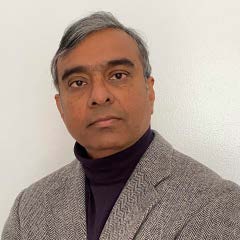 The Achievement Award is given to individuals who made outstanding contributions to the state of the art in electronic design, automation and testing of electronic systems in their life. To be eligible, candidates must have made innovative contributions that impacted how electronic systems are being designed.
Past recipients have been Kurt ANTREICH (2003), Hugo DE MAN (2004), Jochen JESS (2005), Robert BRAYTON (2006), Tom W. WILLIAMS (2007), Ernest S. KUH (2008), Jan M. RABAEY (2009), Daniel D. GAJSKI (2010), Melvin A. BREUER (2011), Alberto L. SANGIOVANNI-VINCENTELLI (2012), Peter MARWEDEL (2013), Rolf ERNST (2014), Lothar THIELE (2015), Giovanni DE MICHELI (2016), C. L. David LIU (2017), Mary Jane IRWIN (2018), Jacob ABRAHAM (2019), Luca BENINI (2020), Georges GIELEN (2021), Edward A. LEE (2022), Jason Cong (2023), Ingrid Verbauwhede (2024) and Subhasish Mitra (2025).
Krishnendu Chakrabarty is the Fulton Professor of Microelectronics in the School of Electrical, Computer and Energy Engineering at Arizona State University (ASU). He serves as Chief Technology Officer of the Department of War Microelectronics Commons Southwest Advanced Prototyping Hub, a “lab-to-fab” ecosystem with over 200 members and funded by the US CHIPS and Science Act. In addition, he is the Director of the ASU Center for Semiconductor Microelectronics.
Prof. Chakrabarty’s research has significantly advanced electronic design automation and test methodologies for complex integrated circuits and systems. His design-for-test technologies have been adopted by leading semiconductor companies including Intel, Samsung, TSMC, Qualcomm, NXP, and Siemens EDA. Prof. Chakrabarty’s work has been particularly influential in 3D integrated circuit testing and heterogeneous integration, and he received the Semiconductor Research Corporation (SRC) Technical Excellence Award, recognized as a “Guru” in design for test methodologies that are “Best in Class”.
Another major component of Prof. Chakrabarty’s research lies in design automation techniques for digital microfluidic biochips---programmable lab-on-a-chip platforms that automate biochemical experiments using electronically controlled droplets. Technologies based on his research have been deployed in diagnostic and sequencing platforms by companies such as Illumina, GenMark, and Baebies. His contributions also include EDA methods for detecting hardware Trojans in integrated circuits and for identifying and mitigating security vulnerabilities in cloud FPGA platforms, thereby extending design-for-test and validation methodologies to address security and trust in modern computing systems. He further demonstrated that postPress Release deployment patching can mitigate hardware vulnerabilities discovered during field operation, extending the concept of patching beyond software.
Prof. Chakrabarty has pioneered research in trust and assurance for biomolecular protocols and microfluidic biochips for healthcare. He introduced tamper-free routing fabrics, bio-protocol watermarking, bioassay locking, secure real-time assay execution, and molecular barcoding to defend against biochemical attacks.
Prof. Chakrabarty has been widely recognized by numerous honors and awards. These include the IEEE Computer Society Technical Achievement Award, the IEEE Circuits and Systems Society Charles A. Desoer Technical Achievement Award, the IEEE Circuits and Systems Society Vitold Belevitch Award, the SRC Innovation Award, the SRC Aristotle Award for mentoring, the IEEE Test Technology Technical Council Bob Madge Innovation Award, the Humboldt Research Award from the Alexander von Humboldt Foundation, the IEEE-HKN Asad M. Madni Outstanding Technical Achievement and Excellence Award, and the Distinguished Alumnus Award from the Indian Institute of Technology, Kharagpur. He and his students have published 20 award-winning papers at major venues including the IEEE Transactions on Computer-Aided Design of Integrated Circuits and Systems, IEEE Transactions on VLSI Systems, ACM Transactions on Design Automation of Electronic Systems, International Conference on Computer-Aided Design, and Design, Automation and Test in Europe Conference.
Prof. Chakrabarty has held numerous international academic appointments and maintained extensive collaborations with universities worldwide. He has been Visiting Professor at University of Bremen as a Humboldt Research Awardee, Hans Fischer Senior Fellow at the Technical University of Munich, Humboldt Research Fellow and Visiting Professor at the University of Potsdam, Honorary Chair Professor at National Tsing Hua University in Taiwan, and Visiting Professor at the University of Tokyo and the Nara Institute of Science and Technology in Japan. He currently serves as a Research Ambassador of the University of Bremen.
Prof. Chakrabarty has been a Visiting Professor at NVIDIA and a consultant to Synopsys and Cisco Systems. He has also served as Editor-in-Chief of IEEE Design & Test, ACM Journal on Emerging Technologies in Computing Systems, and IEEE Transactions on VLSI Systems. Prof. Chakrabarty is a Fellow of the National Academy of Inventors, ACM, IEEE, and the American Association for the Advancement of Science (AAAS).
EDAA is a non-profit association. Its purpose is to operate for educational, scientific and technical purposes for the benefit of the international electronics design and design automation community. The Association, in the field of design and design automation of electronic circuits and systems, promotes a series of high-quality technical international conferences and workshops across Europe and cooperates actively to maintain harmonious relationships with other national and international technical societies and groups promoting the purpose of the Association. EDAA is the main sponsor of DATE, the premier Design, Automation and Test Conference and Exhibition in Europe.
Share this page on social media